Selling wholesale baked goods to local coffee shops, restaurants, or boutique grocery stores is a dream milestone for many bakers. It represents predictable, recurring revenue that doesn't require answering a single Instagram DM or organizing a Saturday morning pickup window.
A cafe owner ordering three dozen croissants every single morning, seven days a week, is the backbone of a stable commercial bakery.
But wholesale pricing (Business-to-Business, or B2B) operates on entirely different financial physics than Business-to-Consumer (B2C) retail pricing. If you simply give a coffee shop a 50% discount off your retail price without running the exact mathematical formulas, you will quickly find yourself working 80 hours a week just to break even.
Here is the ultimate guide to the wholesale bakery pricing calculator, ensuring your B2B partnerships actually generate profit.
Understanding the Profit Triangle
In retail (selling a cookie directly to a customer for $4.00), the profit margin belongs entirely to you. You absorb the labor, the ingredient cost, and you keep the resulting profit.
In wholesale, you are splitting the profit triangle with a middleman.
The coffee shop buying your cookie does not want to sell it for $6.00 and anger their customers. They want to sell it for your standard retail price of $4.00. Therefore, to make their necessary profit margin, they have to buy it from you at a significant discount.
The industry standard wholesale discount usually falls between 20% and 40% below retail price.
Step 1: Discovering Your Absolute Bottom (COGS)
Before you offer a single discount, you must know your true Cost of Goods Sold (COGS). This is the absolute core of the wholesale bakery pricing calculator.
If you are baking a batch of 12 giant chocolate chip cookies:
- Ingredients: $4.80 ($0.40 per cookie)
- Labor: $6.00 (15 minutes of labor at $24/hour, assuming you are utilizing large commercial mixers and efficient batching)
- Direct Packaging: $1.20 (You don't need individual fancy cellos for wholesale; you use large bulk bakery boxes to transport them to the cafe).
- Total Cost to Produce 12 Cookies: $12.00
- Base Cost Per Cookie: $1.00
If your coffee shop wants a massive discount, $1.00 is your absolute "survival line." If you sell the cookie for $0.99, you are physically paying them to eat it.
Step 2: The Retail vs. Wholesale Multiplier
Knowing your cost is $1.00 per cookie, how do we price it?
The Retail Formula
Most bakeries aim for a 25% to 30% COGS in retail. This means the cost to make the item should only be roughly one-quarter to one-third of the final selling price.
- $1.00 Cost × 3.5 Multiplier = $3.50 Retail Price.
- (Your Gross Profit = $2.50 per cookie).
The Wholesale Formula
When selling to a coffee shop, you cannot use a 3.5 multiplier, or the coffee shop will refuse to buy it (because they won't have room to mark it up). Instead, wholesale bakeries aim for a 50% to 60% COGS.
- $1.00 Cost × 2 Multiplier = $2.00 Wholesale Price.
- (Your Gross Profit = $1.00 per cookie).
Step 3: Why Lower Profit Margins Still Make You Rich
When a baker looks at the math above, they panic. "Why would I sell a cookie to a cafe and only make $1.00 in profit, when I can sell it on my website and make $2.50?"
The Answer: Volume and Predictability.
- Zero Marketing Cost: You do not have to write a single Instagram post, pay for ads, or answer DMs to sell those wholesale cookies. The cafe does the marketing for you.
- Zero Customer Acquisition Friction: You process one single huge payment from the cafe owner at the end of the month, instead of processing dozens of $3.50 credit card transactions from individual customers.
- Production Efficiency: Baking 50 cookies requires almost the exact same setup and cleanup time as baking 10 cookies. As your volume increases to meet wholesale demands, your labor cost per cookie drops drastically.
While the profit margin percentage is undeniably lower in wholesale, the gross total dollars in your bank account grow much faster because the volume is guaranteed every single week.
Step 4: Strict Minimum Delivery Requirements
The profit from a $2.00 wholesale cookie instantly evaporates the moment you put it into your delivery van.
You cannot drive across town to deliver six cookies to a cafe. The cost of gas and the 30 minutes of delivery labor will destroy your $6.00 profit.
You absolutely must implement strict Wholesale Order Minimums.
For a local coffee shop receiving fresh deliveries:
- Minimum Order Quantity (MOQ): e.g., $50 to $75 minimum per delivery drop.
- Delivery Fees: Either bake the cost of the delivery driver into a slightly higher wholesale price (e.g., $2.15 per cookie instead of $2.00), or charge a flat $10 delivery fee if the order is under a certain threshold.
The Digital Wholesale Portal
Running a wholesale operation means juggling massive, recurring invoices. If you rely on the cafe owner texting you their weekly order ("Hey, make it 40 muffins tomorrow instead of 20"), those texts will get lost, the invoice will be wrong, and the relationship will sour.
As your bakery expands into B2B sales, your intake software must handle the complexity of dedicated wholesale accounts.
By operating a professional digital storefront like CakeVision, you can create hidden, password-protected menus exclusively for your wholesale partners. The cafe owner logs in, sees their specific $2.00 wholesale pricing (while the public still sees the $3.50 retail price), and manages their recurring orders autonomously. You receive clean data, correct invoices, and seamless payments.
Ready to let customers design their cake?
Set up your AI-powered cake design tool in under 3 minutes. Free to start.
Start FreeFAQ
Should I offer "Consignment" to a new coffee shop?
No. Consignment means you place your pastries in their display case for free, and they only pay you for what actually sells. If a muffin sits there and goes stale, you absorb the loss. Consignment is a terrible deal for perishable food items. Wholesale means they buy the pastry outright; if they fail to sell it, that is their loss, not yours.
Does my cottage food permit allow me to sell wholesale?
In the vast majority of US states, absolutely not. Because wholesale adds a middleman (the food is passing through another entity before the end consumer eats it), it breaks the "direct-to-consumer" rule of almost all cottage food laws. To sell wholesale, you generally must be operating out of a licensed, inspected commercial kitchen facility.
How do I approach a coffee shop to buy my pastries?
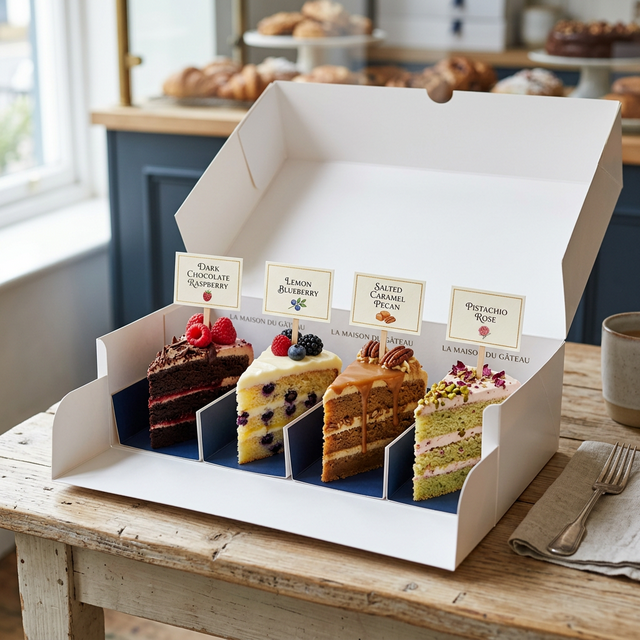
Do not send a cold email; restaurant owners' inboxes are nightmares. Walk in during their slowest time of day (usually 2:00 PM on a Tuesday, never 8:00 AM on a Monday). Ask to speak to the owner or manager. Hand them a beautiful, professional bakery box containing a free sample of your top four items. Say: "I'm a local commercial baker expanding our wholesale accounts. I'd love to leave these for you and your staff to try. My contact info and wholesale pricing sheet are inside." Then leave. If the pastries are incredible, they will call you.