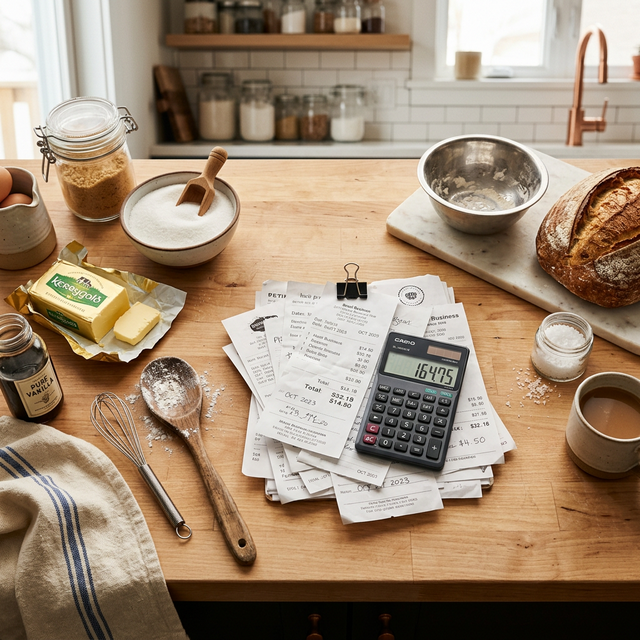
Filing taxes as a home baker is often a harsh awakening. Many new cottage food operators look at their gross revenue (e.g., $15,000 for the year) and panic, assuming they owe massive taxes on that entire amount.
The reality of running a small business is that you are only taxed on your net profit—the money left over after all your business expenses are deducted.
If you aren't aggressively tracking your expenses and utilizing tax write-offs, you are essentially tipping the IRS with your hard-earned profit. Every bag of flour, every delivery mile, and every custom cake box can be deducted to lower your taxable income.
Here is the definitive guide to cottage food tax deductions in 2026, and exactly what you can (and cannot) write off on your Schedule C.
1. Cost of Goods Sold (COGS)
This is your largest and most obvious category. Cost of Goods Sold refers to the direct raw materials required to create the specific product you sold.
If you bake a custom wedding cake, every single physical element that goes into that specific cake is entirely deductible.
- Ingredients: Flour, sugar, butter, vanilla extract, food coloring, fondant.
- Physical Hardware: Cardboard cake circles, internal wooden dowels, bubble tea straws.
- Packaging: Cake boxes, bakery twine, custom logo stickers holding the box closed.
Crucial Rule: You only deduct COGS for items that were actually sold that year. If you buy 500 lbs of flour on December 30th, but don't use it until the following year, it technically counts as next year's deduction (inventory asset), not this year's expense.
2. Operating Expenses
Operating expenses are the costs of running your business that are not directly tied to one specific cake. Even if you didn't sell a single cake this month, you still had to pay these expenses to keep the business alive.
- Marketing & Advertising: Facebook/Instagram Ads, business cards, bridal show booth fees, website hosting (like Squarespace or Shopify fees).
- Software Subscriptions: Accounting software (QuickBooks), design tools (Canva Pro), and specialized bakery management platforms (like CakeVision).
- Education & Training: Did you buy a $200 online masterclass on how to pipe vintage cakes? That is a deductible business education expense.
- Insurance & Licenses: Your annual cottage food permit fee, LLC renewal fee, and your general liability insurance premium.
- Small Tools & Equipment: Spatulas, piping tips, mixing bowls, cake pans. (Note: Massive equipment, like a $1,500 stand mixer, is often depreciated over several years rather than deducted all at once, depending on how your accountant handles it.)
3. The Home Office / Kitchen Deduction
This is where home bakers get the most confused. Can you write off your mortgage because you bake in your kitchen?
Yes, but only a strict percentage. The IRS allows a deduction for the "business use of your home." You must calculate the exact square footage of the space used exclusively and regularly for business, divided by the total square footage of your house.
- Example: If your house is 2,000 sq ft, and your dedicated bakery storage pantry and specific business desk area equals 200 sq ft, your business use percentage is 10%.
- You can then deduct 10% of your indirect home expenses, including rent/mortgage interest, property taxes, homeowner's insurance, electricity, gas, and water bills.
Caution: The IRS is notoriously strict about the "exclusive use" rule. You cannot technically deduct your entire kitchen square footage if your family also uses that exact same kitchen to cook dinner every night. Consult a CPA on how aggressive you can be with your specific layout.
4. Vehicle & Delivery Mileage
If you drive your personal car to deliver a 3-tier wedding cake to a venue 40 miles away, or drive to Restaurant Depot to buy 50 lbs of butter, that driving is a deductible business expense.
There are two ways to track this:
- Standard Mileage Rate: (The easiest method). The IRS sets a specific rate every year (e.g., 67 cents per mile). You simply multiply your total business miles by this rate. If you drove 1,000 miles for deliveries, you get a $670 deduction.
- Actual Expenses: This requires you tracking every gas receipt, oil change, and tire rotation for the entire year, and then deducting the exact business percentage of those costs.
The Golden Rule of Mileage: You absolutely must keep a contemporaneous mileage log. You cannot just guess "I think I drove 500 miles" at the end of the year. You need a dedicated notebook in your glovebox or a tracking app (like MileIQ) recording the date, destination, and exact mileage of every single business trip.
The Chaos of the Shoebox
You cannot legally claim these deductions if you cannot prove you spent the money.
Many home bakers shove hundreds of faded grocery store receipts into a shoebox all year, bringing it to a terrified accountant in April. This chaotic method guarantees you will lose out on thousands of dollars in deductions because receipts go missing or the ink fades completely.
You need a digital paper trail.
When you use CakeVision to run your bakery, the platform integrates seamlessly with your financial ecosystem. Because all your revenue flows through one centralized, digital dashboard, reconciling your income against your tracked expenses becomes a streamlined, automated process. Instead of spending 40 hours in April trying to remember if a $45 charge from June was for personal groceries or business vanilla extract, your finances are neatly categorized, allowing you to hand your CPA a clean report and maximize your tax return.
Ready to let customers design their cake?
Set up your AI-powered cake design tool in under 3 minutes. Free to start.
Start FreeFAQ
Can I write off the groceries I use to "practice" new recipes?
Yes. Ingredients purchased specifically for Research & Development (R&D) to test new menu items or practice decorating techniques are fully deductible business expenses, even if that specific cake is never sold to a customer.
Can I write off my cell phone bill?
If you use your personal cell phone to answer customer DMs, take photos of your cakes, and manage your social media, you can deduct a percentage of your bill. You cannot deduct 100% of it unless it is a dedicated, separate phone line utilized exclusively for the business. Typically, bakers write off around 30% to 50% of their personal cell bill.
What happens if I lose a receipt?
If you are audited by the IRS and cannot produce a receipt or a clear bank statement proving the expense, they will disallow the deduction, and you will owe back taxes and penalties on that amount. Always take photos of physical receipts immediately and store them in a dedicated cloud folder (like Google Drive). Digital proof is perfectly acceptable.