What's Defining Wedding Cakes in 2026
Wedding cakes have always been a mirror of the cultural moment. In 2026, that moment is defined by three converging forces: a hunger for deep personalization, a growing awareness of sustainability, and a renewed appreciation for handcraft as a form of artistry.
Brides are arriving at consultations with mood boards curated over months. They know the difference between a palette knife swoop and a bench scraper finish. They ask about local flower sourcing. They want to see their exact venue colors reflected in the tier gradient. The era of the generic white fondant cake with piped roses is firmly behind us.
For bakers, this shift is both a challenge and an opportunity. The brides who care this deeply are also the ones willing to pay for work that matches their vision. Understanding what is trending — and more importantly, why — is the first step toward positioning your bakery to capture that business.
Pressed Flower and Botanical Cakes
Real edible flowers and foliage, either pressed directly into soft buttercream or suspended between layers of poured fondant, have moved from niche to mainstream. The appeal is immediate: botanical cakes look genuinely one-of-a-kind because no two flowers press identically.
Pansies, violas, chamomile, and lavender are the most popular choices because they are food-safe, widely available, and press flat without losing color. Brides love that the flowers feel authentic — because they are.
Execution tips: Build a relationship with a local edible flower supplier so you can guarantee freshness and confirm food-safe cultivation. Press flowers in advance and store between parchment. Apply them to chilled buttercream so they adhere without sinking. Offer seasonal collections tied to what is actually available — this adds a sustainability story that resonates strongly with today's couples.
Minimalist Elegance
Restraint is having its moment. A single-tier cake with one perfectly placed sugar magnolia. Three smooth tiers in warm ivory with a single ribbon of dried grasses at the base. Minimalist wedding cakes look effortless, but executing them well requires technical precision — every imperfection is visible when there is nothing else to distract from it.
The trend reflects broader design sensibilities borrowed from architecture and interior design, where negative space is treated as an active design element rather than an absence of ideas.
Execution tips: Invest time in perfecting your smooth buttercream technique. The show is the surface, so the surface must be flawless. Price these cakes honestly — brides sometimes assume minimal design means lower cost, and it is worth educating them that a technically perfect finish often takes more time than a heavily decorated one.
Metallic and Jewel Tones
Gold leaf remains a staple, but 2026 is pushing the palette further. Copper accents, burnished bronze, and hand-applied antique gold leaf are pairing with deep jewel-toned buttercream bases: emerald, burgundy, sapphire, and forest green. The effect is romantic and maximalist without being fussy.
These cakes photograph exceptionally well, which drives organic social sharing — a meaningful side benefit for bakeries investing in their online presence.
Execution tips: Source high-quality edible gold and copper leaf; cheaper varieties oxidize and dull quickly. Apply leaf with a dry brush to dry or lightly set buttercream. For jewel-toned buttercream, gel color is your ally — liquid color will never produce true depth. Practice layering shades to avoid flat, uniform tones.
Textured Buttercream
The palette knife technique — broad, confident strokes of buttercream that leave visible texture — has been building momentum for several years and shows no sign of slowing. Rustic swoops, raked lines, and deliberately imperfect finishes celebrate the handmade nature of the work.
Couples drawn to this style value authenticity and warmth over formal precision. These cakes pair well with garden and barn venues, as well as intimate elopement-style celebrations.
Execution tips: Develop a small repertoire of signature textures you can reproduce consistently. Photograph each variation in good light and build a specific portfolio section for texture work. Offer two or three named finishes (rather than open-ended customization) to streamline consultations and set accurate expectations.
Sculptural and Geometric
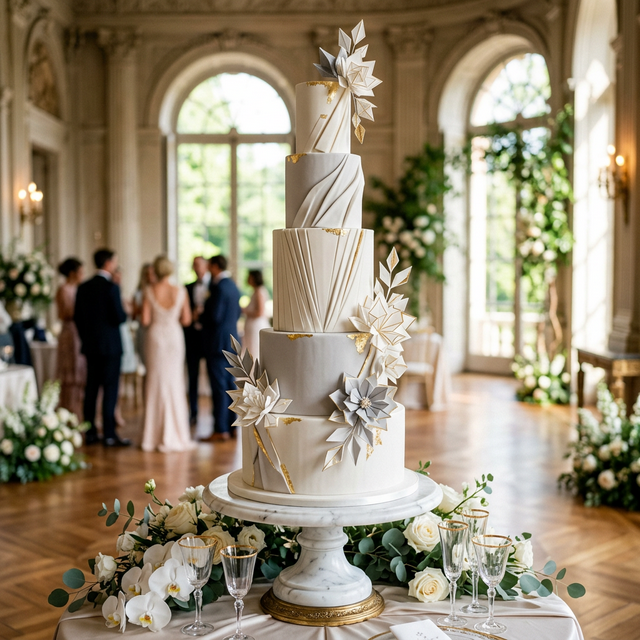
Hexagonal tiers, angular asymmetry, floating layers, and architectural precision — sculptural cakes demand serious structural planning and are the clearest expression of cake as art object. This style appeals to brides with backgrounds in design, architecture, or fine art, and to couples planning modern urban weddings.
Execution tips: Structural integrity is non-negotiable. Dowel systems must be engineered for the specific design. Build a relationship with a local engineer or study structural cake design formally if you are new to this category. Charge accordingly — these cakes carry significant risk and require significant skill. Document your build process and use it as marketing content.
Watercolor and Hand-Painted
Soft gradient washes, loose painted florals, and abstract edible brushwork turn the cake's surface into a canvas. Watercolor cakes are endlessly adaptable — they can be delicate and pastel or bold and saturated depending on the couple's palette.
The skill ceiling here is high, which makes it a strong differentiator for bakers who invest in developing it.
Execution tips: Practice on spare fondant panels before applying to a live cake. Use high-quality food-safe paint and work in thin, layered washes to build depth without muddying colors. Offer to match the bride's exact wedding color palette — this level of customization is difficult to commoditize and justifies premium pricing. See our guide on how to price custom cakes for help structuring quotes on high-skill work.
Naked and Semi-Naked
Couples who want warmth, casualness, and a farm-to-table aesthetic continue to request naked and semi-naked cakes. The exposed layers, fresh fruit, and seasonal greenery give these cakes a lived-in, abundant feeling that contrasts sharply with the formality of traditional fondant designs.
Despite being around for nearly a decade, this style has proven durable because it pairs well with so many venue types and because fresh, seasonal decoration keeps it feeling current year after year.
Execution tips: Manage expectations around stability and timing — naked cakes are more sensitive to temperature and humidity than fully frosted designs. Build delivery timing into your contract. Seasonal fruit is your friend: what is available and beautiful in June is completely different from October, and leaning into that specificity elevates the work.
Personalized Cake Toppers
Custom toppers are having a renaissance driven by improved access to laser cutting, 3D printing, and bespoke figurine artists. Couples want toppers that actually look like them, that reference a shared inside joke, or that incorporate a meaningful symbol — a specific landmark, a beloved pet, an heirloom motif.
This trend is about emotional resonance. The topper is the part of the cake that gets saved, photographed on its own, and kept for decades.
Execution tips: Build a referral relationship with one or two reliable topper artisans. Offer to coordinate the topper order as part of your service — removing that task from the couple's list is a meaningful convenience. Acrylic laser-cut toppers can be sourced quickly and inexpensively; ceramic and resin figurines require longer lead times, so build that into your consultation timeline.
Ready to let customers design their cake?
Set up your AI-powered cake design tool in under 3 minutes. Free to start.
Start FreeHow to Stay Ahead of Trends
Trend awareness is necessary, but it is not sufficient. What separates the bakeries that thrive in this environment from those that scramble are three things: continuous skill investment, strategic portfolio building, and the ability to show brides what a trend actually looks like on their specific cake.
On skill investment: identify which two or three of the trends above align with your aesthetic and commit to mastering them deeply rather than offering everything superficially. Take a workshop. Practice on cakes that will not be sold. Build the technical vocabulary to discuss your work with authority.
On portfolio building: every cake you make in a trending style is a marketing asset. Shoot it well. Tag it accurately. Create content that shows your process, not just your results — brides want to understand how the work gets made.
On showing brides their vision: this is where AI-assisted design tools are changing the industry. Tools like CakeVision let brides generate a realistic mockup of their cake before it is ever baked — matching their venue, their color palette, their tier count. When a bride can see a pressed botanical cake with her exact flower species on a four-tier design in dusty rose, the gap between trend inspiration and personal commitment closes dramatically. That leads to faster decisions, fewer revision cycles, and higher conversion at consultation.
FAQ
Which wedding cake trend is most profitable for bakers?
Sculptural and geometric cakes typically command the highest prices due to their technical complexity and structural demands, but they also carry the highest risk and require the most specialized skill. For bakers looking for strong margins without extreme technical overhead, metallic and jewel-tone designs offer an excellent balance: they are visually dramatic, photograph well, and require techniques that most experienced decorators can develop relatively quickly. Watercolor cakes are similarly profitable once the painting skill is established, because the technique is difficult to outsource or commoditize.
How do I convince brides to choose a trend that matches my skills?
The most effective approach is to lead with your portfolio, not with options. Rather than presenting a bride with a menu of ten trend styles, open your consultation by showing your five most recent cakes that represent your strongest work. Let her react before you ask questions. Brides are drawn to confidence and craft — if she sees something she loves in your actual work, she will want to stay in that territory. If you use an AI design tool to generate mockups, you can iterate quickly within your skill set, showing her multiple variations of a style you execute well rather than generating concepts you would struggle to reproduce.
Are multi-tier wedding cakes still popular in 2026?
Yes, unambiguously. Multi-tier cakes remain the default expectation for most formal weddings, and that is unlikely to change. What has shifted is that brides are increasingly open to unequal tier sizes, asymmetric arrangements, and mixing tier shapes — a hexagonal middle tier flanked by round tiers, for example. The "floating tier" look, achieved with a clear acrylic support column, has grown meaningfully in popularity. Single-tier cakes have also grown as an option for intimate celebrations, often paired with a separate cutting cake. The category is expanding rather than contracting.