The only thing more stressful than baking a flawless, towering 3-tier wedding cake is driving it on a highway to the venue.
Every tiny pothole feels like a canyon, every red light feels like a disaster, and the persistent terror that a hard brake will send a $1,200 piece of edible art sliding off the seat is enough to give any baker severe anxiety.
The sad truth is that a surprising number of beautiful cakes never make it to the display table. They buckle, they slide, or the top tier collapses into the base. But almost 100% of these disasters are preventable. A cake that is structurally sound will survive almost any reasonable car ride.
This is the ultimate, anxiety-reducing guide on how to transport a tiered cake safely.
1. The Engineering: Internal Doweling (Non-Negotiable)
A tiered cake is not a stack of cake layers. It is a system of scaffolding hidden inside the cake. The cake itself should support absolutely zero weight from the tier above it.
If you place a 6-inch cake directly on top of an 8-inch cake, the laws of gravity dictate that the 6-inch cake will eventually sink into the soft crumb of the base tier.
The Support Dowels
Every lower tier must contain support dowels cut exactly flush with the top of the icing.
- What to use: High-quality, thick plastic dowels (like bubble tea straws or poly-dowels) are ideal because they can be cut precisely with shears and carry massive amounts of weight. Traditional wooden dowels work but are harder to cut perfectly flush and can splinter.
- How many: A standard configuration features one central dowel and an outer ring of dowels inset about an inch from the edge of the upper tier. For an 8-inch base holding a 6-inch top tier, you generally need 5 to 6 thick support dowels.
The Central Structural Dowel
For a cake traveling 2+ tiers high, an internal central dowel driven straight through the entire cake from top to bottom is highly recommended.
- You must sharpen a long, sturdy wooden dowel.
- Drive it straight down through the center of the top tier, through the cardboard cake board supporting the top tier (you must pre-punch an aligning hole or hit it hard with a hammer), down through the base tier, and into the thick bottom presentation drum.
- This central dowel acts like the spine, preventing horizontal sliding when you turn the car.
2. Temperature Control: The Chill Factor
Never transport a room-temperature cake. Ever.
A cake at room temperature is mechanically soft. Warm buttercream shifts, cake layers are springy, and subtle road vibrations will cause the heavy ingredients to settle, creating bulges or "blowouts" on the sides of the cake.
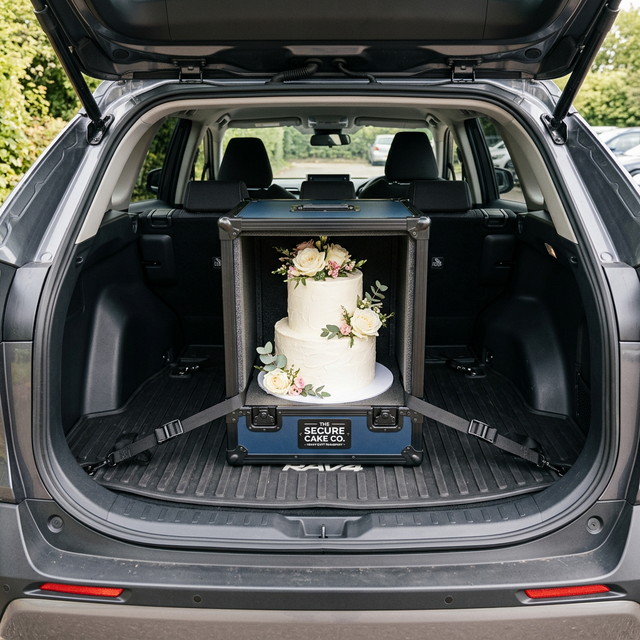
The Box: Always box your cake. A heavy-duty, corrugated cake transport box protects the cake from sudden stops, dust, floating car debris (like dog hair), and insulates it against the temperature of the car.
The Chill: The cake must be violently cold. Leave your fully assembled and decorated tiered cake in a commercial refrigerator overnight, or at the absolute minimum, 4 to 6 hours before transport. A highly chilled, solid brick of butter and cake will not bulge, it will not slide, and it can withstand the bumps of a highway exactly as it is without shifting.
3. The Vehicle Setup: Eliminating Variables
The inside of your car is an active threat to your cake. You must eliminate all movement.
The Placement
Never place a tiered cake on a car seat. Car seats are angled slightly backward for human comfort. If you place a heavy object on a 15-degree slope, gravity will slowly pull the top tier backward until it rips the cake apart.
- The Floorboard: The passenger-side floorboard is often the flattest, most secure surface in a sedan. Move the passenger seat all the way back.
- The Flat Trunk/Cargo Area: If you drive an SUV or a hatchback, a completely flat, cleared cargo area is the professional standard.
The Non-Slip Mat
Buy a roll of cheap, rubberized cabinet liner (non-slip grip mat).
- Place a square of this mat on your car's floor or trunk space.
- Place the cake box heavily onto the mat. This simple $5 investment completely eliminates horizontal sliding during turns. The box will grip the floor like glue.
The Climate
Your car must be freezing. Turn the Air Conditioning to max capacity (the coldest setting, highest fan) and cool the car down for at least 10 minutes before you place the cake inside. If the sun is beating through the windows, place large sunshades on the glass to protect the box from direct radiant heat. Do not transport a cake during the hottest part of an August afternoon if you can avoid it.
4. Driving Logistics and The "Baker's Toolkit"
Driving a wedding cake requires a distinct, cautious mindset.
- Drive exactly the speed limit.
- Brake early and softly. Sudden deceleration creates massive shear force that snaps internal dowels.
- Take turns at half the speed you normally would.
The Emergency Baker's Toolkit
Even with absolute perfection, sometimes a tiny smudge occurs when pulling the cake out of the box at the venue. Never arrive at a delivery without an emergency repair kit.
Your kit must include:
- An offset spatula.
- A piping bag filled with the exact shade and consistency of the outer buttercream used on the cake.
- A pair of tweezers (for retrieving rogue dust particles or fixing florals).
- Paper towels and wet wipes (to clean the presentation board).
- A small leveler.
- Extra structural flowers or garnishes.
5. Controlling the Variables Before the Order
The vast majority of cake transport anxiety stems from miscommunication. If a bride expects a hyper-delicate, unsupported 4-tier whipped-cream cake driven three hours down a dirt road in July, the cake is doomed before it enters the oven.
A structured business prevents these disasters during the consultation phase by setting firm expectations. Instead of managing unrealistic requests via chaotic Instagram DMs, point your clients to a digital storefront.
CakeVision allows you to set the boundaries immediately. You can legally require non-refundable retainers, establish delivery radius limits, and utilize AI visual design to show the customer exactly what structural shape is physically possible within their budget. When a customer uses a professional quoting flow, they understand they are buying a logistical masterpiece, not just dessert.
Ready to let customers design their cake?
Set up your AI-powered cake design tool in under 3 minutes. Free to start.
Start FreeFAQ
Should I deliver tiered cakes fully assembled or stack them at the venue?
For a 2-tier or even a small 3-tier cake (e.g., 10-inch, 8-inch, 6-inch), delivering fully assembled is usually the safest route if the cake is thoroughly doweled and violently chilled. However, for massive 4+ tier cakes, or cakes traveling more than an hour on rough roads, professionals generally deliver the cake in two assembled halves and stack the final tiers directly on the display table at the venue to prevent center-of-gravity disasters.
How do I charge for cake delivery without losing money?
Never offer free delivery for a tiered cake. Your delivery fee must compensate you for your time, vehicle wear-and-tear, and the massive liability of transporting hundreds of dollars of fragile product. The industry standard is typically an hourly rate covering both the drive there and the drive back (e.g., $30 - $50 per hour), plus the standard IRS mileage rate to cover fuel and vehicle depreciation.
Does fondant transport better than buttercream?
Generally, yes. Fondant is essentially a layer of sugar dough that seals the cake. When chilled, it becomes quite firm and acts as an external shell, protecting the soft cake layers underneath from minor bumps and providing significantly more structural rigidity than soft American buttercream in an unstable car environment.