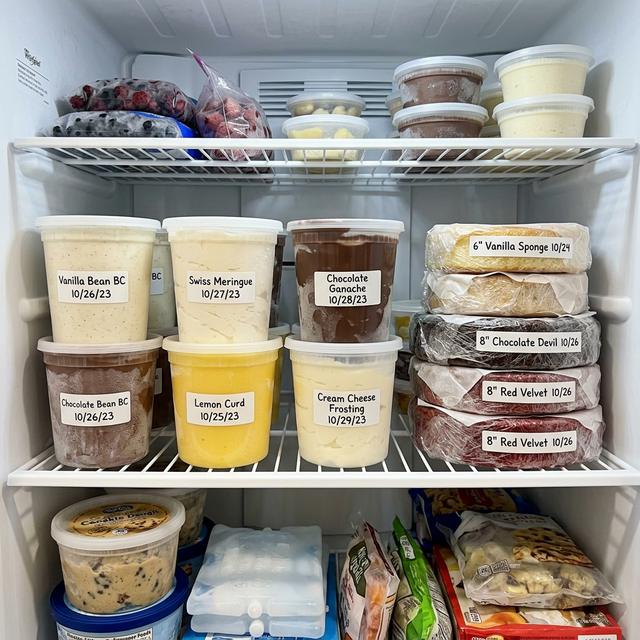
Fulfilling six distinct custom cake orders in a single weekend out of a standard home kitchen is a massive logistical challenge. If you attempt to bake six layers, allow them to cool, whip six batches of fresh buttercream, and execute the final decorating all on a Friday afternoon, you are absolutely going to be awake until 4:00 AM.
The secret to scaling a home bakery without inducing a nervous breakdown is prep work. And the king of bakery prep work is the freezer.
You probably already know you can (and should) freeze your cake sponges to lock in moisture. But the most common question hesitant home bakers ask is: "Can you freeze buttercream?"
The answer is yes, absolutely. Almost every professional bakery in the world freezes buttercream. Here is exactly how to freeze, store, and—most importantly—revive your frosting so it tastes like you made it three minutes ago.
Why You Should Be Freezing Buttercream
Freezing buttercream is not about taking shortcuts disguised as low quality; it is about protecting your time and maximizing your product consistency.
- Efficiency: Mixing a triple batch of Swiss Meringue Buttercream (SMBC) takes about 25 minutes. Making three single batches on three different days takes roughly 75 minutes. The freezer saves you 50 minutes of active labor.
- Zero Waste: If you pipe a massive floral display and have two cups of deep navy blue frosting leftover, throwing it away is literally throwing butter and expensive food coloring into the trash. Freezing it preserves your profit margin.
How Different Buttercreams Handle the Freezer
Not all frostings are created equal when exposed to sub-zero temperatures.
1. American Buttercream (ABC)
Composition: Butter/Shortening + Powdered Sugar + Milk/Cream ABC is essentially indestructible. Because it is highly stable and lacks an egg base or water emulsion, it freezes flawlessly for up to 3 months. It rarely separates when thawing.
2. Swiss Meringue (SMBC) & Italian Meringue (IMBC)
Composition: Egg Whites + Granulated Sugar to 160°F+ + Massive Amounts of Butter These meringue-based buttercreams are emulsions (a precarious suspension of fat and water). They freeze beautifully for 2 to 3 months, but they will look terrifying when you thaw them. They regularly "break" or curdle upon thawing, requiring a specific revival technique (detailed below) to fix them.
3. Cream Cheese Frosting
Composition: Cream Cheese + Butter + Powdered Sugar Exercise caution. High-fat, low-water cream cheese frostings freeze okay for short periods (1 month), but lower-fat cream cheese frostings can become granular or watery when thawed. Always test your specific recipe in a small batch before relying on the freezer for a massive wedding order.
The Freezing Process: How to Store It Correctly
Air and strong odors are the enemies of frozen frosting. If you freeze a bowl of vanilla buttercream next to a frozen lasagna, your buttercream will taste like garlic in 48 hours.
- Portion Control: Never freeze a massive 6-quart bowl of frosting. If you only need a cup later, you will have to thaw the whole brick. Portion the leftover frosting into usable amounts (e.g., 2-cup increments).
- The Ziplock Method: The most space-efficient storage method is transferring the buttercream into heavy-duty freezer bags. Lay the bag flat on the counter and press out as much air as physically possible before sealing.
- The Deli Container Method: For stiffer frostings, pack them tightly into heavy-duty plastic deli/soup containers (the kind restaurants use), pressing a piece of plastic wrap flush against the surface of the frosting before snapping on the lid to prevent freezer burn.
- Labeling (Crucial): Always write the exact date, flavor, and color directly on the bag with a permanent marker. "Pink Vanilla 10/12" avoids devastating mix-ups three months later.
Thawing and Reviving Buttercream (The Critical Step)
This is where the magic happens (and where panicking bakers throw perfectly good frosting in the trash).
Step 1: The Gradual Thaw Do not aggressively microwave a frozen brick of buttercream. Move the bag or container from the freezer to the refrigerator the night before you need it. Let it slowly come down in temperature over 12 hours. Then, an hour before decorating, move it to the counter until it reaches room temperature.
Step 2: The Re-Whip (Solving the "Broken" Emulsion) If you are reviving American Buttercream, a quick stir with a stiff rubber spatula might be all it needs.
If you are reviving Swiss or Italian Meringue Buttercream, it will often look like curdled cottage cheese swimming in liquid butter. Do not panic. It is not ruined. The emulsion has simply broken because the fat and water separated as they reached room temperatures at slightly different rates.
- Place the curdled frosting directly into your stand mixer bowl fitted with the paddle attachment.
- Turn the mixer to medium-low.
- Let it run. It will sound soupy and look horrific.
- The Fix: If it stays soupy, the butter is still too cold. Take a hair dryer (or a kitchen torch) and gently heat the outside of the metal mixing bowl for 15 seconds while the paddle runs. The edges will melt slightly, binding the cold center, and the emulsion will instantly lock back into a pillowy, glorious cloud.
Staying Organized in the Kitchen
A well-stocked freezer is the hallmark of a professional bakery. But a professional bakery also requires an organized order queue.
Wasting time managing DMs and guessing when you need to pull vanilla buttercream from the freezer for a nebulous order is stressful. By implementing CakeVision as your digital storefront, every single order is logged instantly with clear pickup dates and AI-visualized specs, allowing you to glance at your dashboard on a Sunday, prep your frostings, freeze them, and sleep peacefully throughout the week.
Ready to let customers design their cake?
Set up your AI-powered cake design tool in under 3 minutes. Free to start.
Start FreeFAQ
How long does thawed buttercream last on the counter?
Meringue-based buttercreams (SMBC/IMBC) and American Buttercream are shelf-stable at a cool room temperature (below 72°F / 22°C) for several days. Because the sugar content acts as a preservative and the egg whites in meringue frostings are fully cooked to 160°F+, they do not require immediate refrigeration upon thawing.
Can I re-freeze buttercream that I have already thawed once?
While technically safe from food-poisoning perspective if handled correctly, repeatedly freezing and thawing fat-based emulsions degrades their structure. The frosting will eventually become granular or lose its ability to hold a sharp edge when piped. Try to thaw only what you need.
My revived Swiss Meringue is full of air bubbles, how do I smooth it?
After you have successfully re-emulsified the frosting with the paddle attachment, it will likely be saturated with massive air bubbles created by the mixing friction. Turn your mixer down to the absolute lowest "Stir" setting. Let the paddle run agonizingly slowly through the frosting for 5 to 10 minutes. This slowly forces the large air pockets out of the fat matrix, returning the frosting to a silky, perfectly smooth consistency ideal for sharp cake edges.


