When you start baking from home, insurance is often the last thing on your mind. You are focused on finding the perfect vanilla bean paste, mastering sharp edges, and figuring out how to price a 3-tier wedding cake.
Then one day, an intrusive thought hits: "What if someone chips a tooth on an uncracked almond shell in my macarons? What if someone claims my buttercream gave the entire wedding party food poisoning?"
The sobering reality of running a food business is that you are accepting a baseline level of liability every time you hand a box to a customer. And the most dangerous misconception in the cottage food industry is believing that your standard homeowner's or renter's insurance policy will protect you. It absolutely will not. If you use your home kitchen for a commercial enterprise, residential policies explicitly void your coverage for business-related claims.
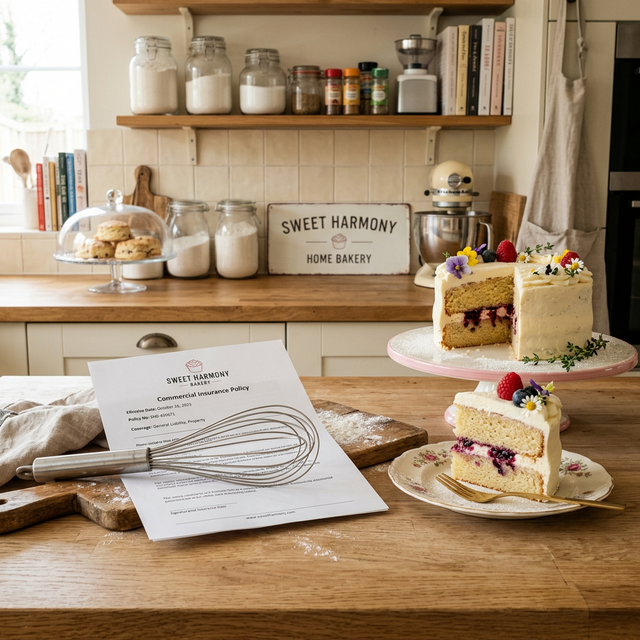
If you are selling baked goods to the public, you need dedicated business insurance. This guide breaks down exactly what policies matter for a home baker, what they protect you against, and the literal dollar cost of peace of mind in 2026.
The Only Insurance That Truly Matters: General Liability
There are dozens of insurance types, but for a home-based cottage baker, you fundamentally require General Liability Insurance (specifically a policy tailored for food vendors).
A standard food-vendor liability policy usually covers three catastrophic scenarios:
1. Product Liability (The Food Poisoning Claim)
This is the big one. If a customer alleges that they contracted Salmonella from your underbaked cookies, or suffered a severe allergic reaction because of cross-contamination in your kitchen, product liability defends you. Even if you are meticulously clean and completely innocent, defending against a frivolous lawsuit costs tens of thousands of dollars in legal fees. The insurance covers the defense lawyers and any potential settlements.
2. Bodily Injury and Property Damage
If a bride places an order for a massive, heavy 4-tier cake, and your delivery driver (you) drops it on her venue's antique hardwood floor, shattering the floorboards and ruining the dress of a bridesmaid standing nearby—general liability covers the property damage to the venue and the cleaning/replacement of the dress.
3. Personal and Advertising Injury
If you unintentionally use a copyrighted logo on a batch of corporate cookies, or if another bakery sues you for allegedly copying their specific "trade dress" (branding and style), this facet of the policy helps cover the legal defense regarding those advertising torts.
What Does Baker Insurance Actually Cost in 2026?
Many bakers operate illegally without insurance because they assume a commercial policy costs $3,000 a year.
This is entirely false.
Because cottage bakers operate in low-risk environments (you don't have heavy foot traffic in a retail storefront, you don't serve alcohol, and you don't use deep fryers), insurance companies view you as incredibly cheap to insure.
The Industry Standard: FLIP (Food Liability Insurance Program)
For thousands of home bakers in the United States, obtaining a policy through groups like FLIP or Next Insurance has become the default.
- The Annual Premium: A standard $2 Million General Liability policy specifically tailored for a cottage food baker generally costs between $299 and $350 per year.
- Monthly Breakdown: That is roughly $25 to $30 a month. That is the cost of two blocks of premium butter.
If you are charging acceptable profit margins on your cakes, a single custom cake order per year will entirely pay for your annual insurance premium. If you cannot afford $300 a year to protect your personal savings, your home, and your vehicle from being liquidated in a lawsuit, your business is a hobby, not a sustainable enterprise.
When Do You Need "Additional Insured" Riders?
If you only sell cakes out of your home to residential customers, a base policy is usually sufficient. However, if you plan to scale your business, you will encounter the phrase "Additional Insured."
- Farmers Markets: Almost every legitimate farmers market requires vendors to hold a $1 million liability policy. Furthermore, they will require you to add the market organization to your policy as an "Additional Insured" (meaning your insurance protects them if a customer sues the market because of your food). Adding an entity to a FLIP policy is usually free or costs a nominal $10 fee.
- Wedding Venues: High-end, luxury wedding venues will frequently refuse to let you set foot on their property to deliver a cake unless you can email them a Certificate of Insurance (COI) listing the venue as an Additional Insured.
If you lack insurance, you are immediately locked out of the most lucrative corporate and wedding avenues in the industry.
The Unseen Value of Being Insured
Beyond the obvious legal protection, telling your clients you are "fully licensed and insured" is a massive marketing tool.
When a bride is choosing between you (charging $800) and an uninsured hobbyist on Facebook (charging $400), citing your insurance signals absolute, unshakeable professionalism. It justifies your premium pricing because the customer subconsciously understands they are hiring a legitimate business entity, not a rogue kitchen operator.
You can further amplify that professionalism by abandoning chaotic Instagram DM ordering and adopting a structured digital storefront. Using CakeVision to intake orders, visually confirm AI designs, and log customer specifications proves to your clients that your operational backend is as professional as your insured status.
Ready to let customers design their cake?
Set up your AI-powered cake design tool in under 3 minutes. Free to start.
Start FreeFAQ
Does LLC status mean I don't need insurance?
No. This is a common and dangerous misunderstanding. An LLC (Limited Liability Company) protects your personal assets (your house, your personal bank account) if the business is sued. But without insurance, the LLC itself will be bankrupted by the lawsuit, destroying your equipment, business cash, and completely ending your bakery operation. You absolutely need both the LLC structure and the liability insurance policy working together.
Will business insurance cover my damaged equipment?
Standard General Liability covers damage you inflict on others. If you drop your $800 KitchenAid mixer and shatter the motor, a standard liability policy will not replace it. To protect your heavy equipment from theft or fire, you must purchase an "Inland Marine" rider (usually an extra $50-$100 a year) or a Business Owner's Policy (BOP) that explicitly covers your physical business property.
Does cottage food insurance cover shipping baked goods across state lines?
Most cottage food insurance policies require you to operate strictly within the bounds of your state's cottage food laws. Because almost all cottage food laws prohibit shipping food across state lines (interstate commerce falls under strict federal FDA jurisdiction), your insurance company will likely deny coverage if a lawsuit arises from an illegally shipped out-of-state cookie order. Always read the geographic limitations of your specific policy.