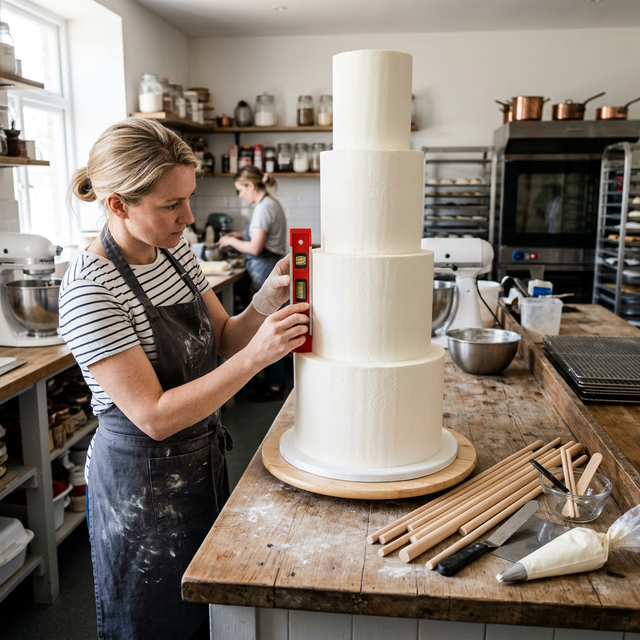
You bake a perfect vanilla sponge. You trim the tops totally flat. You stack three layers with a beautiful, thick raspberry compote filling. You spend an hour achieving a flawlessly smooth buttercream exterior with razor-sharp edges. You put it in a box, go to sleep, and feel like a professional.
The next morning, you open the fridge to find a disaster. Running horizontally around the middle of the cake, right where the filling is located, is a massive, unsightly roll of fat. The dreaded "buttercream bulge."
When cake layers violently settle and compress the soft filling outward, the pristine exterior frosting ruptures. The bulge cannot be easily scraped away; attempting to fix it usually tears the cake open further.
The only way to cure the buttercream bulge is to prevent it from ever happening through aggressive structural engineering during the stacking phase.
The Root Cause of the Bulge
A bulge is pure physics.
- Weight: An 8-inch cake layer is incredibly heavy. When you stack three of them, gravity dictates that the heavy cake will crush whatever soft matter is caught between the layers.
- Air: Freshly baked cake has air trapped inside of it. As the cake sits (especially under the weight of other layers), those air pockets compress. A 5-inch tall stack of cake will naturally settle to about 4.7 inches over 12 hours.
- Temperature: If the filling is soft and room-temperature, it has zero structural integrity. When the heavy cake presses down, the soft filling takes the path of least resistance: outward.
Step 1: The High-Integrity "Dam" System
If you are filling your cake with anything softer than dense buttercream (like lemon curd, raspberry jam, whipped ganache, or cream cheese), you cannot simply spread it to the edge of the cake.
You must pipe a structural wall, known as a "Dam."
- Stiff Frosting is Required: Take your standard buttercream and add ½ cup of powdered sugar to a small portion of it to make it aggressively stiff.
- The Piping Technique: Place the stiff frosting in a piping bag with a medium round tip (like a Wilton 12) or simply snip the end off the bag. Pipe a thick, unbroken ring directly around the extreme outer edge of your cake layer.
- The Fill: Spoon your soft, precarious filling inside the ring. Do not let the filling rise slightly higher than the piped wall.
- The Cap: Place the next heavy cake layer on top. The cake layer rests its weight securely on the stiff, unyielding buttercream dam, preventing it from crushing the soft curd in the center.
Step 2: The Re-Chill
Never attempt to put the final layer of smooth exterior frosting on a cake that is soft and room temperature.
Once you have stacked your three cake layers and filled them with dams, you must perform a "Crumb Coat" (a painfully thin, semi-transparent layer of frosting designed just to seal in crumbs).
Immediately place the crumb-coated, stacked cake into the refrigerator for at least 30 minutes, or the freezer for 15 minutes.
The cold temperature does two things:
- It forces the butter in your dam to solidify, creating a literal brick wall containing the filling.
- It solidifies the cake crumb, forcing the cake to stop settling and shifting.
Step 3: The "Turtleneck" and The Resting Period
Even with a stiff dam, a massive wedding tier might still settle a fraction of a millimeter over the span of 12 hours. If you add the final layer of exterior icing immediately, the cake will settle underneath the icing, causing the icing to ripple.
If you have the luxury of time, professional bakeries utilize the Resting Method.
- Stack the cake with proper dams and fillings.
- Do NOT apply the final icing.
- Instead, wrap the entire stacked, un-iced cake tightly in plastic wrap (the "turtleneck"). Make sure it’s snug.
- Place a completely flat, heavy object on top of the cake. (A plastic cutting board or a clean, heavy ceramic plate works perfectly).
- Leave it for 2 to 4 hours at cool room temperature.
The heavy weight forces the cake to undergo its natural "settling" process instantly, while the tight plastic wrap forces the walls to remain perfectly plumb. When you remove the weight and the plastic wrap four hours later, the cake has finished settling forever. You can now aggressively frost it, knowing the internal structure will never shift again.
Preventing Operational Disasters
Structural failures like bulging usually happen when a baker is rushing because they accepted too many chaotic orders. When you spend three hours panic-baking on a Friday night, you skip the Resting Period or fail to chill the dam properly.
The most effective way to eliminate these rushed structural errors is to tightly control your order calendar.
Using CakeVision as your ordering platform completely organizes your capacity. It stops customers from sending frantic DMs demanding a multi-tier cake for "tomorrow." By establishing clear online storefront rules, automated lead-time restrictions, and utilizing AI-design mockups so you understand exactly how tall a cake needs to be weeks in advance, you afford yourself the luxury of time. And in cake decorating, time to chill a cake properly is the most valuable structural ingredient of all.
Ready to let customers design their cake?
Set up your AI-powered cake design tool in under 3 minutes. Free to start.
Start FreeFAQ
Why does my buttercream bulge only happen when I transport the cake?
If a cake looks perfect in your fridge but develops a bulge during a 20-minute car ride, you are treating the symptoms, not the cause. The vibration of a moving vehicle massively accelerates the settling process. If the dam was soft, or the cake hadn't finished settling at the bakery, the road vibrations force the heavy tiers to rapidly compress. You must rest and violently chill the cake prior to transport to solidify the structure against vibration.
I followed all the steps and my cake still bulged. What went wrong?
If you piped a dam, chilled the cake, rested it, and it still bulged, the dam itself failed. The most common culprit is piping the dam inside a ring of soft filling (the filling slipped under the dam), or using a dam frosting that was way too soft and airy. Your dam frosting should be so stiff that piping it requires serious hand strain. The dam must touch the dry cake crumb directly to anchor itself.
Should I insert dowels into a single, tall tier to prevent bulging?
If the single cake tier (e.g., three layers of an 8-inch cake) is taller than 6 inches in total height, yes. The sheer weight of that much cake will inevitably crush the bottom filling layer regardless of your dam integrity. For any cake approaching double-barrel heights (6 to 8 inches tall), you must insert a structural cake board halfway up the tier resting on internal bubble straws to relieve the crushing downward pressure.


