The simplest question every new home baker asks is also the most frustrating to answer: "Can I just start selling my cakes?"
If you bake an incredible chocolate cake for a family barbecue and your cousin’s friend hands you a $50 bill to make one for her son’s birthday next week, doing so without a license seems harmless. But the moment you exchange money for a food product, you cross a strict legal boundary.
If you are wondering, "Do I really need a license to sell baked goods from home?" the short answer is yes. You almost universally need some form of legal permission. However, the type of permission you need depends entirely on where you live.
This guide untangles the bureaucratic web for beginners so you can start selling confidently without fear of the health department knocking on your door.
The First Hurdle: Cottage Food Laws
You do not necessarily need a commercial kitchen license or a massive health department inspection to sell cookies from your home kitchen. What you need is to operate under your state or country's Cottage Food Laws.
Cottage food laws were explicitly created to allow small-scale entrepreneurs to sell low-risk, "non-potentially hazardous" foods (like cookies, breads, and buttercream cakes) directly to consumers without the crushing expense of building out a commercial facility.
How to Get Your Cottage Food "License"
Depending on your state, this "license" takes different forms:
- The Free Registration (easiest): States like Texas or Wyoming only require you to take a basic online food handler's course (usually about $15) and properly label your baked goods with a specific disclaimer. No actual "license" application is required.
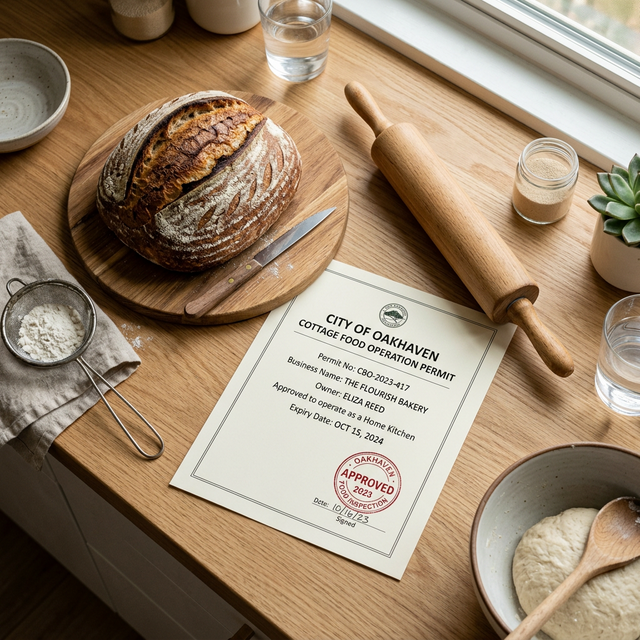
- The Permit Application (moderate): States like New Jersey or California require you to submit an official application, pay an annual fee (e.g., $100), submit your recipes for approval, and sometimes provide a mock-up of your packaging labels.
- The Inspected Permit (strict): A minority of states require an actual home kitchen inspection before you are granted a permit. The inspector checks your refrigerator temperatures, requires dedicated ingredient storage separate from family food, and ensures no pets are in the kitchen area.
Action Item: Google "[Your State] Cottage Food Law Permit" today and read the requirements from your official state health or agriculture department website.
The Second Hurdle: Local Zoning Laws
This is the legal roadblock most new bakers completely ignore until they receive a cease-and-desist letter.
Your state might have wonderful, progressive cottage food laws allowing you to bake, but your local city or county municipality controls "zoning." Zoning dictates what activities are allowed in a residential neighborhood.
If your city explicitly forbids operating a retail business out of a residential home, the state cottage food law does not magically override that.
Why do cities care?
Local governments are not trying to crush your cookie dreams; they are trying to prevent traffic and disturbances in quiet neighborhoods. If you have 40 customers driving through a residential cul-de-sac every Saturday morning to pick up boxes of pastries, your neighbors will complain.
What you need: You usually need to apply for a Home Occupation Permit or a general local Business License through your city clerk’s office. This usually involves signing an agreement stating you will not have massive delivery trucks arriving daily or heavy customer traffic severely impacting the neighborhood.
Note for Renters: If you rent your home or apartment, or live in a neighborhood governed by an aggressive Homeowners Association (HOA), you must check your lease or bylaws. Many landlords explicitly forbid operating a commercial enterprise on the property due to liability concerns.
The Third Hurdle: The Tax ID (EIN) and LLC
You can technically operate under your own name and social security number as a "Sole Proprietor," but this is professionally dangerous.
The EIN (Employer Identification Number)
An EIN is like a social security number for your business. It is completely free to obtain from the IRS website in about five minutes. You need an EIN if you want to open a dedicated business bank account. Mixing your personal grocery money with your cake revenue in one debit account is an accounting nightmare that will make tax season pure misery.
The LLC (Limited Liability Company)
If Mrs. Smith claims your buttercream gave her entire wedding party food poisoning and sues you for medical damages, operating as a Sole Proprietor means she can potentially sue for your personal savings, your car, or your house.
Forming an LLC creates a legal wall between your personal assets and your business liabilities. If the business is sued, only the business's assets are at risk. Forming an LLC usually costs between $50 and $500 depending on your state. It is an investment in your peace of mind.
The Final Defense: General Liability Insurance
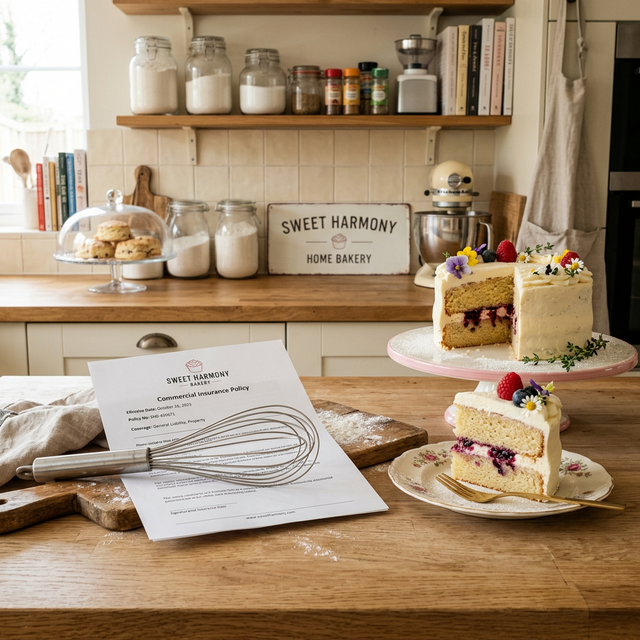
A permit makes you legal; insurance makes you safe.
Never sell a baked good to the public without a basic General Liability Insurance policy tailored for food businesses (e.g., FLIP - Food Liability Insurance Program). It protects you against claims of bodily injury (foodborne illness, allergic reactions from cross-contamination) or property damage. It usually costs less than $300 a year.
If you cannot afford to pay $300 for a year of insurance, you cannot afford to start a food business.
Operating Professionally From Day One
Once you have your permits filed and your insurance purchased, you are running a real business. Do not immediately undermine that professionalism by running your entire operation through chaotic Instagram direct messages.
When you transition from "baking for family friends" to "operating a licensed home bakery," your systems need to upgrade too.
Implementing proper ordering software like CakeVision gives you a digital storefront, a structured intake questionnaire, and clear visual design tools. It prevents miscommunications, automatically logs order details into a dashboard, and makes your newly licensed home bakery look like a high-end commercial operation from the very first click.
Ready to let customers design their cake?
Set up your AI-powered cake design tool in under 3 minutes. Free to start.
Start FreeFAQ
What happens if I sell baked goods from home without a license?
If you are caught (usually because a competitor reports you or a disgruntled customer complains), you will typically receive a warning and a cease-and-desist letter from the health department. If you ignore it, you face heavy fines, confiscation of equipment, and potentially being permanently barred from obtaining a food service license in the future.
Does my kitchen need to pass a health inspection?
In most states operating under standard Cottage Food Laws, no. The premise of the law is that non-hazardous baked goods do not require commercial-grade sanitation protocols. However, some stricter states (like California's Class B permit, or states lacking broad cottage laws) do require an inspector to walk through your home kitchen.
Can I sell cakes with cream cheese frosting from home?
Under strict interpretation of most cottage food laws, no. Cream cheese frosting has high moisture and dairy content, classifying it as a "potentially hazardous food" requiring refrigeration, which is strictly banned from home production. Some states allow it if you pay to have your specific recipe lab-tested to prove its water activity (Aw) and pH levels render it shelf-stable, but this is a complex hurdle.