The moment you hand a customer a custom cookie and accept a $50 Venmo payment, you are legally a business owner in the eyes of the government. And while making money baking from your kitchen is incredibly fulfilling, dealing with the resulting tax bill in April can be deeply alarming.
Because home bakeries have low overhead compared to commercial storefronts, many cottage bakers drastically under-report their business expenses. If you do not track your deductible expenses, you will artificially inflate your "profit," meaning you will pay significantly higher taxes than you legally owe.
A "tax write-off" (or deduction) is simply a legitimate business expense that reduces your taxable income. If you earned $10,000 in revenue but had $4,000 in legitimate business deductions, you are only taxed on $6,000 of profit.
Here is a comprehensive guide to the 15 most common tax write-offs for cottage bakers in 2026.
(Disclaimer: We are software builders, not CPAs. Always consult with a licensed tax professional or accountant regarding your specific business and state laws.)
Direct Cost of Goods Sold (COGS)
These are the immediate, tangible costs required to create your product. You cannot bake without them, making them 100% deductible.
1. Ingredients and Consumables: Every bag of flour, pound of butter, bottle of premium vanilla extract, and tub of fondant you purchase exclusively for the business. (You cannot deduct the milk you used for your child’s cereal, so always purchase business ingredients on a separate receipt). 2. Packaging and Presentation: Cake boxes, corrugated shipping boxes, cellophane bags, cake boards (drums), dowels, parchment paper, custom logo stickers, and ribbons.
Equipment and Depreciation
Baking requires specialized, heavy-duty machinery.
3. Small Wares and Hand Tools: Piping tips, disposable piping bags, offset spatulas, bench scrapers, specific cookie cutters, and food scales. 4. Large Equipment Depreciation: If you purchase a $700 KitchenAid Commercial mixer or a $1,200 specialized countertop oven, you usually cannot deduct the entire cost in a single year. These are considered capital assets. You generally deduct a portion of the cost over several years (depreciation), or use specific tax codes (like Section 179) to deduct it entirely in the purchase year (consult your CPA).
Operations and Software
Running a professional business requires professional tools.
5. Software Subscriptions: This is incredibly common to overlook. If you pay for Quickbooks to track your accounting, Canva to design your Instagram graphics, or an all-in-one ordering platform like CakeVision ($29/mo) to process orders and generate AI mockups, those are absolutely 100% deductible business expenses.
6. Business Cell Phone or Internet: If you use your personal cell phone to answer customer emails or post on Instagram, you can deduct a percentage of your phone bill corresponding to business use. If you have a dedicated business phone line, it is fully deductible.
7. Website Hosting and Domains: Payments for your custom domain name (e.g., www.sarahsbakes.com).
Marketing and Education
Investing in your brand's growth lowers your tax burden.
8. Advertising Costs: Money spent "boosting" posts on Instagram, paying for Facebook localized ads, or paying a photographer to take professional photos of your cakes. 9. Professional Development: The cost of attending an online cookie decorating masterclass, buying a recipe ebook from a famous pastry chef, or attending a bakery business convention. 10. Tasting Boxes and Samples: The ingredient cost of the miniature cakes you give away as "Tasting Boxes" to prospective brides or local wedding venues as marketing.
Logistics and Fees
Moving your money and your cakes comes at a cost.
11. Transaction Fees: When a customer pays you via a Square credit card reader or a business PayPal account, those platforms take a ~3% fee. That fee is a deductible business expense. 12. Business Licenses and Liability Insurance: The cost of your state Cottage Food permit application, your LLC formation fees, and the annual premium for your FLIP (Food Liability Insurance Program) policy. 13. Business Mileage: The IRS allows you to deduct a specific amount per mile (e.g., 67 cents per mile in 2024) for business-related driving. This includes driving to deliver a wedding cake to the venue, driving to the restaurant supply store to pick up 50lbs of sugar, or driving to the post office to ship cookies. Keep a rigorous mileage logbook in your car; you cannot guess this number.
The Home Office / Kitchen Deduction
This is the most complex but potentially lucrative deduction for cottage bakers.
14. The Exclusive Use Area: The IRS allows you to deduct a portion of your rent or mortgage, utilities, and internet if you use a specific portion of your home "exclusively and regularly" for your business. The Catch: This is notoriously difficult for home bakers because the "exclusive use" test means the space cannot be used for personal reasons. Your family kitchen, where you also cook family dinners, usually does not qualify. However, if you have a dedicated spare bedroom converted solely into an ingredient storage pantry and packaging station, the square footage of that specific room can often be calculated as a deduction.
Staying Organized to Maximize Deductions
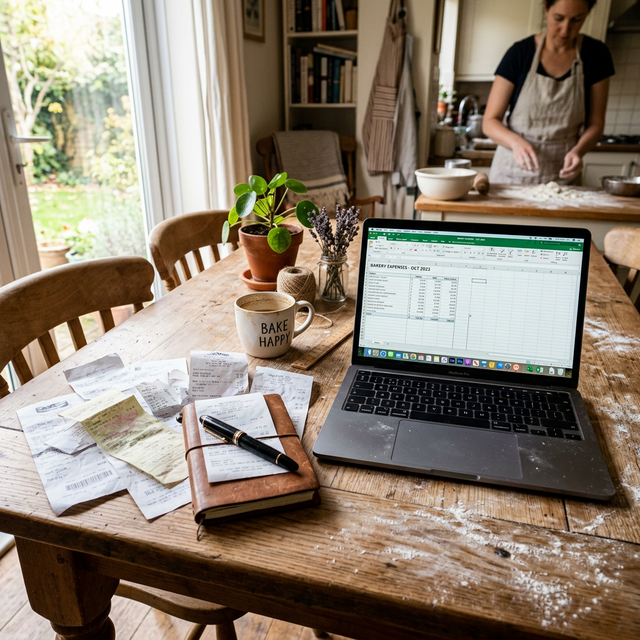
The biggest reason bakers fail to claim these deductions is a lack of organization. If you throw all your receipts into a shoebox and try to decode them on April 14th, you will inevitably leave thousands of dollars in deductions on the table.
The Golden Rule of Bookkeeping: Never, ever mix personal and business funds. Open a dedicated business checking account. All revenue goes into it; all expenses (from flour to your CakeVision subscription) are paid out of it.
When your financial house is in order, you can confidently invest in the tools that actually save you time. Implementing structured ordering software stops the administrative nightmare of DM negotiations, ensures every transaction is fully documented for tax season, and lets you focus on creating highly profitable custom cakes.
Ready to let customers design their cake?
Set up your AI-powered cake design tool in under 3 minutes. Free to start.
Start FreeFAQ
Can I write off the groceries I buy if I occasionally use a little bit for a cake order?
No. This is a massive audit red flag. You cannot buy a gallon of milk for your family, use a splash of it for a custom cake, and write off the gallon of milk. You must purchase your business ingredients in completely separate transactions from your personal groceries, and you should retain the specific itemized receipt proving the items were purely business-related.
What happens if I don't report my Venmo, Zelle, or CashApp income?
If you are operating a business, failing to report income is tax evasion, which carries severe legal and financial penalties. Furthermore, third-party payment processors (like Venmo and PayPal) are required by law to report gross transactions exceeding certain thresholds directly to the IRS (often via a 1099-K form). The IRS already knows about the digital income; if it is missing from your tax return, you will trigger an audit.
Can I deduct the cost of my commute from my bedroom to my kitchen?
No. Commuting from your residence to your primary place of business is never tax-deductible. However, any driving you do from your home bakery to a secondary business location (like driving across town to deliver a wedding cake to a venue or running to a supply store) is considered deductible business mileage. You must track these miles rigorously.


