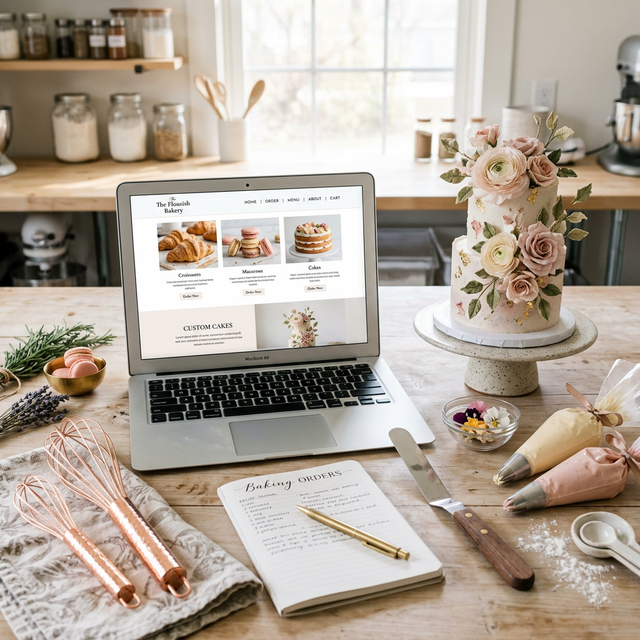
A customer walks in — or emails, or DMs — and says they want a cake for their daughter's birthday. "Something floral, but not too girly. Pastel. Maybe with butterflies? Oh, and she loves the color purple but not dark purple. And can it look elegant but also fun?"
You nod. You ask follow-up questions. You pull up your portfolio. Twenty minutes later, you still are not entirely sure what they mean by "elegant but also fun," and neither are they.
This is the communication gap. And it costs bakeries real money, real time, and real customer satisfaction.
The Communication Gap
Custom cake orders are fundamentally a design problem wrapped inside a food problem. Customers know what they feel — they want something beautiful, personal, meaningful — but most people do not have the vocabulary to describe visual design. They are not trained to think in terms of tier height, piping techniques, fondant texture, or color saturation. So they reach for the closest tool available: the internet.
The result is a Pinterest board with 50 images. Half of them are five-tier sugar-flower showpieces that would require a full pastry team and a week of work. The other half contradict each other in style, color, and complexity. The customer insists they all "capture the vibe."
You, the baker, are now expected to synthesize this chaos into a single cake that matches an expectation that does not yet exist in a concrete form — and then execute it perfectly, on a deadline, for a fixed price.
According to surveys of independent bakery owners, consultations for custom cake orders average between 30 and 60 minutes per order. For a busy bakery handling 15 to 20 custom orders per week, that is up to 20 hours of consultation time alone — before a single egg is cracked.
Beyond time, misaligned expectations are one of the leading causes of negative reviews and refund disputes in custom bakery businesses. A customer who imagined one thing and received another — even a technically excellent cake — is a customer who feels let down. That experience rarely stays private.
What Is AI Cake Design?
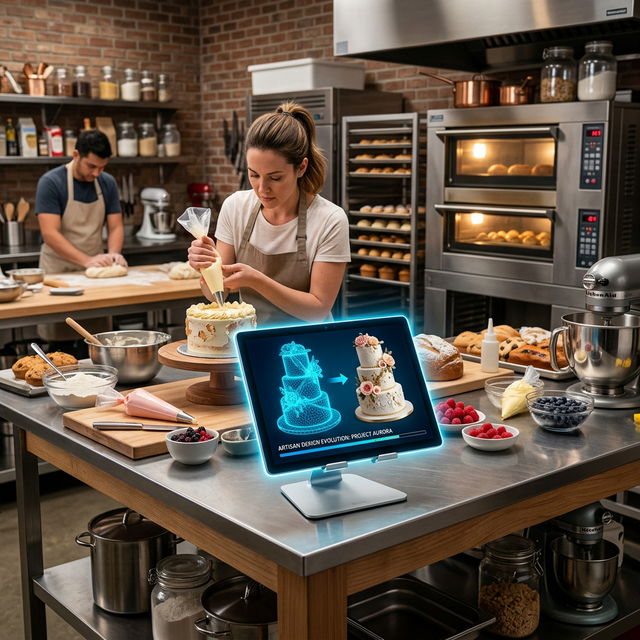
AI cake design is not a robot that bakes your cakes. It is also not the same as asking a general-purpose chatbot like ChatGPT to describe a cake. It is something more specific and more useful: a system that takes structured customer input and generates a realistic visual mockup of what their cake could look like.
The customer answers a guided set of questions — cake size, flavor, occasion, color palette, style, any decorative elements they have in mind. The AI processes those answers and produces one or more photorealistic images of a cake that matches those parameters. The customer can see their idea rendered visually before any commitment is made.
This is meaningful because vision is the fastest path to alignment. Showing someone an image and asking "is this the direction you had in mind?" is a far more productive conversation than asking them to describe their ideal cake from scratch. The image gives both parties a shared reference point. It makes disagreement constructive rather than vague.
Purpose-built AI cake design tools differ from general image generators in one critical way: they are constrained. A general image generator will happily produce a gravity-defying architectural marvel suspended from invisible wires. A well-designed cake tool knows what your bakery can actually produce and keeps the AI within those bounds.
How It Works in Practice
The customer flow through an AI cake design tool looks roughly like this.
First, the customer visits your branded storefront — a page configured specifically for your bakery, with your name, your style categories, and your constraints already built in. They are not on some generic platform; they are in your space.
Second, they work through a guided questionnaire. Not a blank text box. Not an open-ended prompt. A structured series of questions that progressively captures what they want: occasion, number of servings, flavor preferences, color palette, decorative style, any specific elements they want included or excluded. Good tools are designed so that a customer with no design vocabulary can still make meaningful choices.
Third, the AI generates design options based on their answers. The customer can review these, request changes — "a little more rustic," "lighter on the flowers," "more tiers" — and refine until they land on something they feel good about.
When they submit their order, you receive a clean email or dashboard notification with everything you need: the customer's contact information, the finalized design image, and the complete specification from their answers. No back-and-forth, no interpretation required. The brief writes itself.
For bakeries that receive orders outside business hours — and most do, because customers order when the mood strikes, not when you are open — this also means those orders are captured and queued, with a visual spec attached, ready for you to review in the morning.
The Elephant in the Room: Will It Look Like the Design?
This is the question every baker asks, and it deserves a direct answer.
No. The finished cake will not be pixel-for-pixel identical to the AI-generated image. It should not be, and no credible AI cake design tool claims otherwise.
What the AI image is, and what it should be positioned as to your customers, is an inspiration reference and a starting point. It is a directional document, not a technical blueprint. It answers the question "what are we aiming for in terms of style, color, and feel?" not "what are the precise dimensions of each sugar flower?"
This is actually not a new concept in the cake industry. Bakers have always worked from reference images — customer photos, portfolio examples, sketched mockups. The AI image is simply a more personalized version of that same reference. Instead of a photo of someone else's cake that is "kind of what I want," it is a generated image built from the customer's own stated preferences.
The key is in how you frame it. Language matters here. When a customer submits their order, a confirmation message that says something like "Your baker will use this design as the creative concept for your cake" sets the right expectation. The AI image is the brief. The baker's skill is what turns it into reality.
Well-designed tools also address the expectation gap on the front end by constraining what the AI can generate. If your bakery specializes in buttercream and does not work in fondant, the tool should not be producing images of fondant-covered cakes. If you are a two-person operation that maxes out at three tiers, the AI should not be generating five-tier showpieces. The more tightly the tool is configured to your actual capabilities, the smaller the gap between the generated image and the finished product.
Real Benefits for Bakers
The practical impact of AI cake design on bakery operations tends to cluster around a few consistent areas.
Consultation time drops significantly. Bakeries using AI design tools report reducing their per-order consultation time from an average of 45 minutes to under five minutes in most cases. The customer arrives at your door — or your inbox — already having made most of the design decisions. Your job shifts from eliciting information to confirming it.
Orders come in around the clock. A static website cannot take a custom order with real specificity at 11pm on a Sunday. An AI design tool can. The customer completes the whole process, from initial inputs to final submission, without requiring your presence.
Disputes and complaints decrease. When a customer has approved a design before placing an order, the "that's not what I wanted" conversation becomes much rarer. Both parties have agreed on a visual direction. That agreement is documented. Expectations are anchored to something concrete.
The overall customer experience becomes more professional. Independent bakeries often struggle to compete with chain retailers on perception of polish and process. A clean, branded, interactive ordering experience signals to customers that they are working with someone who takes their craft seriously.
For a deeper look at how to structure your pricing around custom orders, see our guide on how to price custom cakes.
Ready to let customers design their cake?
Set up your AI-powered cake design tool in under 3 minutes. Free to start.
Start FreeWhat to Look For in an AI Cake Design Tool
Not all AI cake design tools are built for working bakeries. When evaluating options, consider these factors.
Baker constraints built in. The tool should allow you to configure what you offer — styles, sizes, serving ranges, flavors — and limit AI outputs to what falls within those parameters. An unconstrained AI that generates anything imaginable is not useful for operational order management.
Guided questionnaire, not open-ended prompt. Customers should be led through specific questions, not asked to "describe your dream cake" in a text box. Open-ended prompts produce inconsistent results and do not capture the structured data you need to fulfill the order.
Branded customer-facing storefront. Your customers should feel like they are interacting with your bakery, not a third-party platform. Look for white-label or customizable storefronts that carry your name and visual identity.
Order management and notification system. The design is only useful if it reaches you in a structured way. The tool should deliver clear order notifications — email or dashboard — with the design image and full customer specifications attached.
If you are also evaluating how to bring your custom cake ordering process fully online, our article on how to take custom cake orders online covers the broader operational setup.
FAQ
Is AI cake design accurate enough for real orders?
Yes, with the right framing. AI-generated cake images are not meant to be engineering specifications — they are directional visuals that establish the style, color, and feel of what the customer wants. Used correctly, as an inspiration reference and a shared starting point, they are more than accurate enough to anchor a productive order process. The more tightly the tool is constrained to your actual capabilities, the more aligned the final result will be with the generated concept.
Do my customers need to be tech-savvy to use it?
No. Well-designed AI cake tools use a guided questionnaire format — multiple-choice questions, color pickers, predefined style categories — rather than open prompts or complex interfaces. Customers do not need to know anything about AI or design software. They answer questions about their order, the same way they would in a conversation with you, and the tool handles the rest.
Can I control what the AI generates?
Yes, and this is one of the most important things to verify before choosing a tool. Baker-facing configuration should let you set the parameters the AI works within: the styles you offer, the sizes you produce, the techniques you use. This keeps generated images realistic relative to what you can actually deliver, and it prevents customers from falling in love with a cake concept that is outside your capability or price range.
How much does AI cake design software cost?
Pricing varies by tool and feature set. Some platforms charge a flat monthly subscription, typically ranging from free entry-level tiers for smaller bakeries to $30 to $100 per month for professional plans with full order management, branding, and unlimited design generations. The relevant comparison is not the software cost in isolation — it is the software cost against the consultation hours it replaces. At even $30 per month, a tool that saves 10 hours of consultation time per week represents significant net value for most custom cake operations.