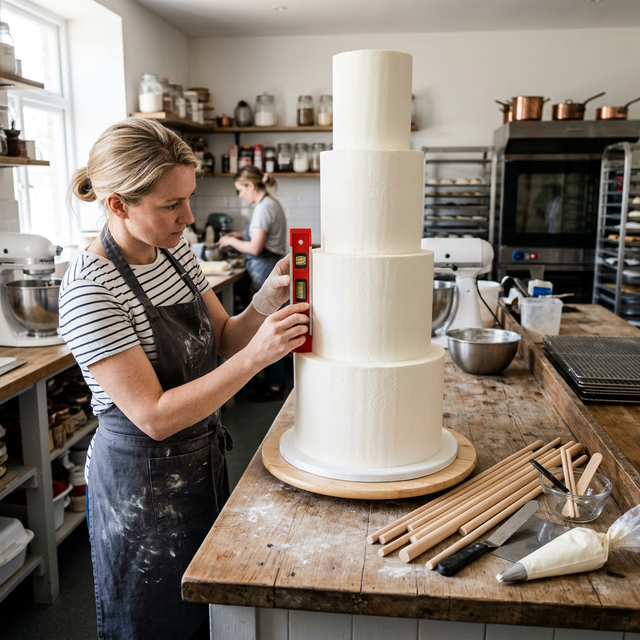
The internet is littered with viral videos of wedding cake disasters. A beautiful three-tier cake sits on a display table. Slowly, agonizingly, the top tier begins to lean sideways. Suddenly, the entire top half of the cake shears off, plunging into a catastrophic explosion of buttercream and ruined sponge on the floor.
The bride is crying. The venue is silent. The baker’s reputation is destroyed.
Almost every single one of these structural failures is caused by a singular, avoidable mistake: improper doweling.
A 10-inch cake layer is incredibly heavy. Unstructured sponge cake fundamentally cannot support the weight of an 8-inch cake, a 6-inch cake, and a 4-inch cake resting directly on top of it. In a stacked cake, the cake below does not support the cake above. The dowels support the weight.
If you are terrified to deliver a multi-tier cake, here is the absolute scientific masterclass on how to dowel a tiered cake in 2026, ensuring it survives transport and the weight of its own ambition.
The Core Concept: Cake Boards and Pillars
Before you insert a single dowel, you must understand the architecture of stacking.
Every single individual tier must be resting on its own sturdy cardboard cake circle. You never place raw cake directly onto the frosting of the tier below it.
The cardboard circle acts as the "floor" of the upper tier. The dowels you insert into the bottom cake act as the "pillars." When you place the upper tier onto the lower tier, the cardboard floor rests entirely on the vertical pillars. Therefore, the immense weight is transferred directly down through the pillars to the table, completely bypassing the actual soft cake crumb of the bottom tier.
The Material Debate: Wooden Dowels vs. Bubble Straws
For decades, bakers utilized solid wooden rods, sawing them manually with a hacksaw. Modern decorators have largely abandoned wood in favor of a vastly superior material.
The Winner: Poly-plastic Bubble Tea Straws.
- Why Wood Fails: Wooden dowels displace a massive amount of cake when inserted, often causing the tier to bulge outward. They are incredibly difficult to cut perfectly level; if one wooden dowel is cut on a slight slant, the tier above it will tilt. Finally, wood is porous and can occasionally harbor splinters or bacteria.
- Why Bubble Straws Win: Massive, wide plastic bubble straws are hollow. When you insert them into the cake, they slice cleanly through the sponge, displacing almost zero volume. They are effortlessly snipped perfectly level with standard kitchen scissors. And because they are wide cylinders, they can support massive vertical weight without buckling.
The Doweling Process: Step-by-Step Accuracy
The number one rule of doweling is mathematical precision. If four dowels are cut to 4.0 inches, and one dowel is accidentally cut to 3.8 inches, the upper tier will wobble and sink over that short dowel, causing a massive blowout on one side of the cake.
Step 1: Establish the Height (The Pilot Straw)
- Ensure your bottom tier is completely frosted, chilled firm, and leveled.
- Take an empty cake board (the exact size of the tier going on top) and lightly press it into the center of the frosted bottom tier to trace a faint circle. This marks where your dowels must go.
- Take one single bubble straw and insert it dead-center into the cake. Push it completely down until it hits the bottom cake board.
- Take a food-safe marker (or make a slight scoring cut) and mark the straw exactly where it meets the top surface of the frosting.
- Pull the straw completely out of the cake.
Step 2: The Perfect Cut
Take the pilot straw and cut it exactly on the mark you made. It must be perfectly flat. Now, use that pilot straw as your master template. Stand five other straws next to it on the counter, and cut them all to the exact same millimeter height. Do not measure the other straws by inserting them into the cake. (Cake heights vary slightly across a surface; all straws must be mathematically identical in height to create a perfectly flat plateau).
Step 3: The Placement Pattern
You must distribute the weight evenly. Do not cluster the straws in the center, and do not place them too close to the edge.
- Place the straws in a wide circle, about 1 inch inside the faint traced outline of the upper tier board.
- Insert the perfectly cut straws straight down into the cake until they hit the bottom board. They should now be perfectly flush with the top surface of the icing.
Step 4: The Center Dowel (For 3 Tiers or Higher)
If a cake is taller than two tiers, it requires a central stabilizing rod to prevent the tiers from sliding horizontally during a car ride. Sharpen one end of a long, thick wooden dowel. After all tiers are stacked (each individually supported by bubble straws), drive the sharpened wooden dowel directly down through the dead center from the absolute top tier, hammering it cleanly through all the cardboard cake circles until it drives into the bottom base board.
How Many Straws Do You Need?
A general rule of thumb for standard 4-inch tall tiers utilizing thick plastic bubble straws:
- Supporting a 4-inch tier: 3 or 4 straws
- Supporting a 6-inch tier: 5 or 6 straws
- Supporting an 8-inch tier: 7 or 8 straws
- Supporting a 10-inch tier: 9 to 11 straws
Note: The dowels are placed in the cake directly beneath the tier they are supporting. E.g., The 10-inch base tier holds the 7 straws required to hold up the 8-inch upper tier.
Structuring Your Bakery Operations
When you master the anxiety-inducing physics of stacking a 4-tier wedding cake, you cross the threshold from amateur to elite professional.
You must treat your bakery administration with the same rigid, unquestionable structure. Relying on chaotic Instagram messages and scattered PayPal invoices is the equivalent of stacking a heavy wedding cake with no internal supports; eventually, the volume will crush the system and revenue will collapse.
When you transition your large-scale orders to CakeVision, you are installing a high-grade structural foundation under your business. The platform manages the heavy lifting of visual intake, complex pricing matrices for tiered cakes, and automated invoicing. The software holds the weight of your unglamorous admin work, allowing you to focus entirely on precise execution in the kitchen without burning out.
Ready to let customers design their cake?
Set up your AI-powered cake design tool in under 3 minutes. Free to start.
Start FreeFAQ
What happens if I use regular thin drinking straws?
The cake will collapse. Standard drinking straws are made from thin, flimsy plastic designed to bend. When the massive weight of a dense multi-tier cake presses down, thin straws immediately buckle and fold in half, offering zero vertical support. You must use thick, rigid boba/bubble tea straws or specialized plastic cake dowels.
Do I put dowels in the absolute top tier of the cake?
No. Dowels are only inserted into a cake layer to support a heavy tier sitting above it. Because the absolute top tier (usually a 4-inch or 6-inch layer) has nothing sitting on top of it, it does not require any internal vertical support straws around its perimeter. (It still gets pierced by the single long wooden center dowel passing completely through the entire cake).
Should I deliver the cake fully stacked, or assemble it at the venue?
This is the ultimate decorator debate. Most professionals agree: if the cake is 3 tiers or shorter, securely doweled, chilled rock-hard, and has a central wooden rod driven through it, it is overwhelmingly safer to deliver fully stacked in a refrigerated vehicle. The sheer anxiety and lack of sanitary conditions when trying to stack and frost gaps on a chaotic venue dance floor in front of catering staff is far riskier than a careful, heavily air-conditioned drive.